Engineering and work orders
Defines the vehicle, required parts and work procedure, and keeps the results.
TITAN. A mobile industrial assistant
within the DIZLR ecosystem.
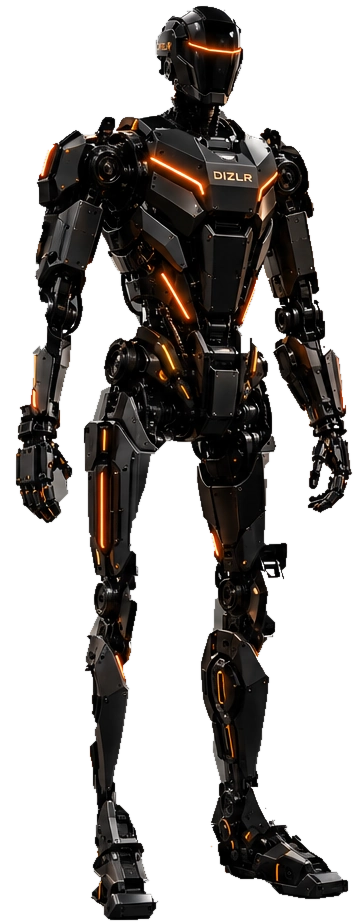
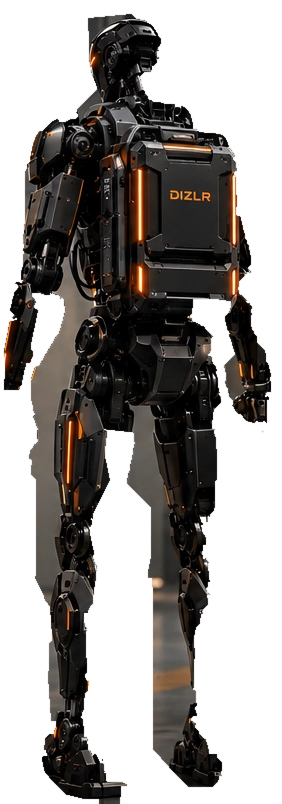
A robot concept that brings parts handling, assembly support and inspection together. With its tools on board, TITAN is designed to move between workstations, carry out a defined task and record the result.
Concept imagery. The specifications are development targets that require engineering validation.
01 / Within the DIZLR ecosystem
DIZLR defines the work, MICRODARK coordinates the assembly cell, and TITAN moves between parts, tools and workstations. Cranes and fixed robot arms continue to handle the tasks best suited to them.
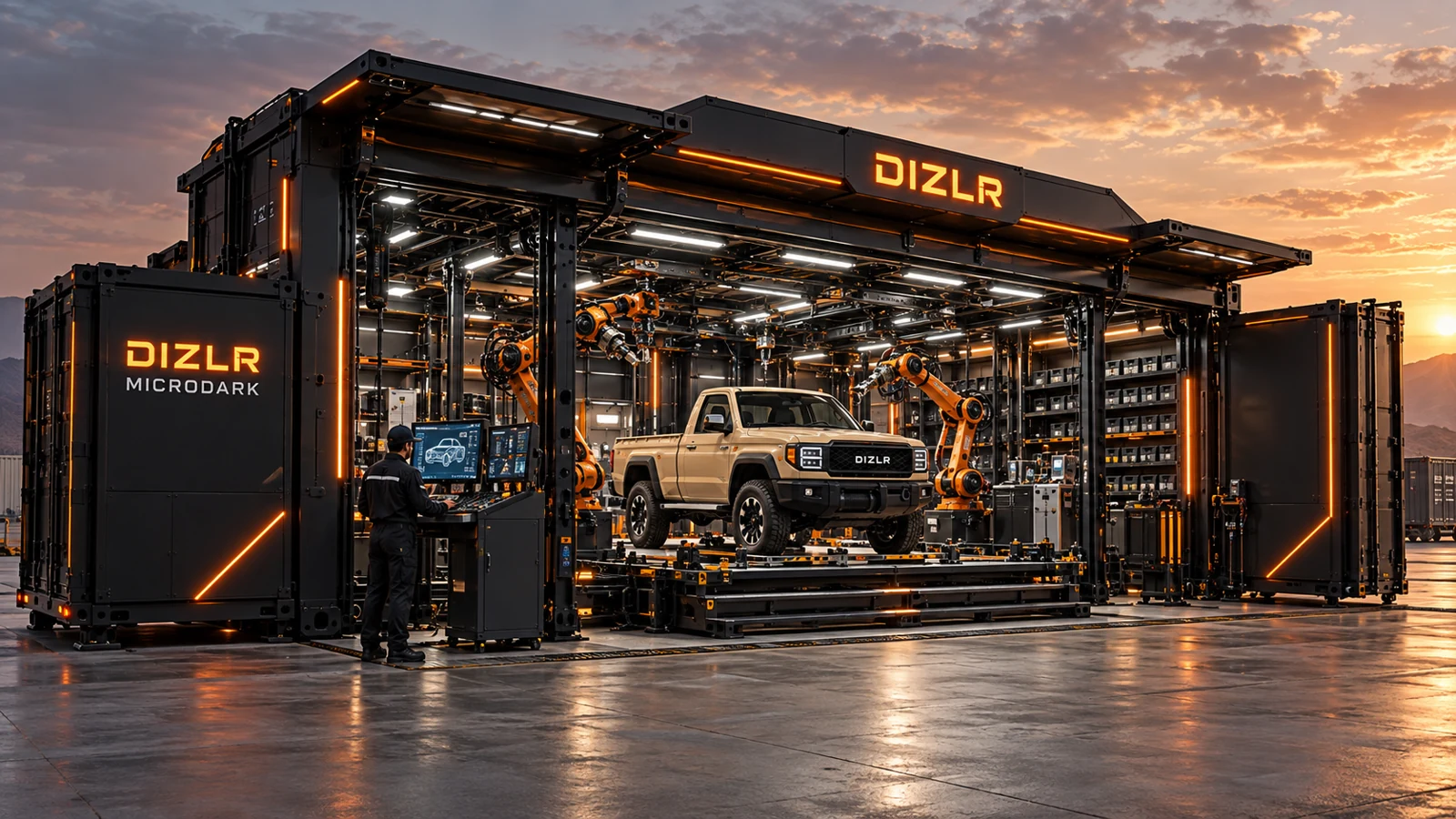 Assembly cell concept · not a photograph of a validated operating facility
Defines the vehicle, required parts and work procedure, and keeps the results.
Makes parts, tools and workstations available, with access arranged around safety requirements.
Handles parts, supports assembly and inspection, and reports the result.
01 / WORK ORDER
DIZLR identifies the vehicle and part, then selects the approved procedure and skill required for the task.
02 / Target applications
Development starts with clearly defined tasks and measurable results. Each task must be tested using the actual parts, tools and conditions it will encounter.
From the delivery point to the workstation.
Receives specified boxes or parts, checks their identity and places them in designated holders within the validated load limits.
Hold. Align. Help fasten.
Positions parts for assembly and uses task-specific tools where there is sufficient access.
A clear result for every step.
Checks that parts are in place, reads identification codes and links tool results to the vehicle record.
The right tool for the task.
Carries tools for the current task, with an external station for larger or specialist equipment.
Organized inspection. Planned service.
Supports inspection rounds, brings maintenance tools and replaces suitable modules after equipment isolation and procedure approval.
Stop when needed. Ask for a decision.
Detects a mismatch or a task it cannot complete, then refers the case to an authorized supervisor.
Engines, cabs and loads beyond the validated range still need suitable lifting equipment. TITAN is an assistant within the system, not a replacement for every machine in the factory.
03 / Explore the design
A black industrial design with illuminated orange details. Explore where its proposed sensing, handling, power and balance systems sit.
04 / Tools on board
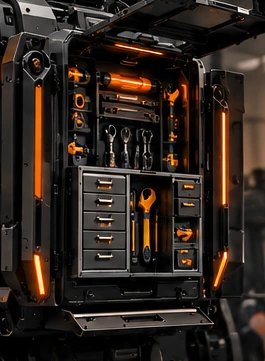
Each tool has an assigned place, an identity and a retaining lock. Larger equipment stays at an external tool station.
Access, weight and tool retention must be resolved in detailed design. These volumes are development estimates, not measurements taken from the image.
05 / Handling engineering
Reach, centre of gravity, tool weight and body position all affect what a robot can carry. Each handling target therefore refers to a specific use case.
At approximately 60 cm reach, in a fixed posture to be validated by testing.
Close to the body, on a level, dry floor and along an approved path.
Close to the body in specified postures; this is not a walking payload.
The figures refer to net workpiece mass. Tool mass also loads the joints, and stored tools affect balance. These targets are not certified operating limits and cannot be added together or applied to every posture.
06 / Proposed control architecture
Three layers share distinct responsibilities: understanding the task, controlling movement and monitoring safety. Instructions select validated skills rather than directly commanding the motors.
Identifies the scene, part and instruction, then selects an appropriate validated procedure.
On-device computing · vision · skill managementCoordinates the body, arms and contact forces through real-time control loops, independently of language-based planning.
Joints · forces · whole-body balanceMonitors critical conditions, interlocks and operating limits, with authority to restrict movement as the application requires.
Risk assessment · monitoring · planned responseA proposed development process. Learning and simulation require task data and real-world validation before production use.
07 / Technical overview
An initial specification for H200. Figures are preliminary engineering targets; candidate components may change after selection and integration testing.
| Item | Target / configuration | Conditions and limitations |
|---|---|---|
| Concept model | TITAN H200 | A proposed configuration name, not a commercially released model. |
| Height | 1.95–2.05 m | Nominal target: approximately two metres. |
| Shoulder width | 70–80 cm | To be reviewed against site aisles and arm movement requirements. |
| Estimated base mass | Approximately 160 kg | Includes battery and grippers; excludes stored tools and the carried workpiece. |
| Core joint axes | 31 axes | 14 in the arms, 12 in the legs, 3 at the waist and 2 in the head. Grippers are excluded. |
| Degrees of freedom per arm | 7 axes | A proposed configuration for controlling tool position and orientation. |
| Target arm reach | 0.80–0.90 m | Shoulder to working point with a standard tool; payload varies with reach. |
| Proposed actuators | Brushless electric motors | Motor, gearbox, bearings and drive. Continuous and peak torque depend on duty cycle and temperature. |
| Proposed load-bearing structure | Aluminium and steel, selected for the loads | Removable outer panels serve the design and do not replace the load-bearing frame. |
| Joint monitoring | Position, temperature, current and torque where needed | Sensors, sampling rates, accuracy and response limits are defined during joint development. |
| Item | Target / configuration | Conditions and limitations |
|---|---|---|
| Workpiece in one hand | 15 kg | Initial target at about 0.60 m reach in a validated fixed posture, not across the full movement range. |
| Workpiece in both hands during controlled movement | 30 kg | Close to the body on a level, dry floor, at speeds and postures to be tested. |
| Workpiece in both hands while standing | 40 kg | Close to the body in specified postures; not a walking payload. |
| Speed while carrying parts | 0.3–0.6 m/s | A development target, not permission to operate at this speed near people. |
| Tool compartment contents | 8–12 kg | Included in mass and balance calculations, affecting the available handling range. |
| Payload definition | Net workpiece mass | Tool, changer and sensor mass also loads the joints. All limits require testing. |
| Item | Target / configuration | Conditions and limitations |
|---|---|---|
| Proposed battery energy | Approximately 4.8 kWh | Target nominal system energy; the final configuration follows duty-cycle measurement. |
| Power bus | Nominal 96 V class | Maximum charging voltage depends on cell selection and differs from nominal voltage. |
| Battery management | BMS + protection and power isolation | Temperature, cell and current monitoring, short-circuit protection and maintenance isolation. |
| Continuity of operation | Battery exchange at a support station | A proposed arrangement using a stable station, suitable chargers and spare batteries. |
| Runtime | Established by measuring the task | Depends on load, movement, computing and cooling; no measured runtime is claimed. |
| Thermal management | Multi-zone cooling and monitoring | Thermal separation of battery and computing hardware, with motor and drive monitoring. |
4.8 kWh nominal battery × 80% assumed usable energy = 3.84 kWh. This is an illustration, not measured runtime.
| Item | Target / configuration | Conditions and limitations |
|---|---|---|
| Proposed architecture | Perception + motion + safety | Separate responsibilities; AI does not override safety limits. |
| Candidate perception computer | NVIDIA Jetson T5000 or equivalent | A Thor-family candidate, not a confirmed component or a partnership announcement. |
| Candidate perception computer memory | 128 GB | A published property of the candidate T5000 component, not a validated DIZLR robot specification. |
| Proposed local storage | 1–2 TB NVMe | Skill versions and records, managed through access and retention policies. |
| Joint control | Approximately 1 kHz target | An independent real-time loop; response times must be measured before approval. |
| Skill management | Train, validate, then deploy | Simulation and learning from demonstrations, with reviewed versions and rollback capability. |
| Item | Target / configuration | Conditions and limitations |
|---|---|---|
| Scene vision | Stereo / depth cameras | For estimating the scene and the approach path to parts. |
| Tool vision | Close-range cameras at the wrists | Local positioning after camera and tool calibration. |
| Force sensing | Six-axis force / torque sensors | At the wrists, with measurement ranges selected for the process and tool. |
| Balance | IMU + foot contact sensors | Combines motion and contact force measurements with joint state. |
| Part identification | Code reading and tool identification | Matches the part and tool to the work order version. |
| Fastening quality | Results from a monitored fastening tool | Arm motor current alone does not prove fastener quality. |
| Item | Target / configuration | Conditions and limitations |
|---|---|---|
| Gross equipment compartment volume | Approximately 24 L | A design volume target; not all of it is available for tools. |
| Estimated internal usable space | 12–18 L | An initial estimate after holders, locks and tool removal clearances. |
| End effector | Interchangeable industrial grippers | The task determines the final gripper. The image does not confirm a five-finger hand. |
| Tool retention | Mechanical lock with status confirmation | With identification of mass, centre of gravity and lock state. |
| Candidate motion network | EtherCAT | For industrial synchronization and control; final compatibility depends on integration testing. |
| Candidate auxiliary connections | CAN FD / Ethernet / GMSL2 | Selected to suit the battery, sensors and cameras. |
| Site connectivity | Ethernet / Wi-Fi | For commands and supervision; balance and safety functions do not depend on internet access. |
| Item | Target / configuration | Conditions and limitations |
|---|---|---|
| Target initial environment | Organized indoor factory | Level, dry floor with approved routes and access procedures. |
| Target ambient temperature | 0–40 °C | Requires thermal validation under actual loads. |
| Target enclosure protection | IP54 | A test target, not a rating or certification the robot has obtained. |
| Protection of people | Application-specific risk assessment | Work zones, stop states and independent monitoring; not a promise of absolute safety. |
| Stopping while carrying a load | A response to be designed and tested | Loss of power must not be assumed to preserve balance or retain a load automatically. |
| Software deployment | Signed versions and access controls | Proposed network separation, controlled updates and command records. |
| Current status | Concept and development specification | Performance, approvals and commercial availability depend on validation. |
The targets on this page belong to the DIZLR concept. Another company's specifications do not validate them. The names below are technical references or candidate technologies, not partners or certifications.
08 / Responsible operation
TITAN is conceived for defined tasks, procedures and work zones. Clear instructions guide the task; an authorized person handles exceptions.
Integration, safety and approvals
depend on the required tests.
09 / From concept to application
A proposed path that starts with the parts, tools and workplace, then measures results before scaling.
Part, weight, reach, tool and the result that counts as success.
Joints, power, vision and grip in a controlled test environment.
Measure cycle time, human interventions, quality and maintenance within the application.
Repeat the validated configuration, supported by training, service and managed updates.
10 / Frequently asked questions
The design, target performance and role within DIZLR.
TITAN is DIZLR's concept for a humanoid industrial robot that carries its own tools and supports parts handling, assembly, inspection and service. This page presents an early design and development targets, not a commercially ready product.
Its intended role is to perform defined tasks within a complete assembly system. MICRODARK coordinates the cell, while suitable lifting equipment handles cabs, engines and heavier parts. TITAN alone does not establish a cell's production rate.
They are net workpiece mass targets for different conditions: 15 kg in one hand at a defined reach and posture, 30 kg with both hands during controlled movement, and 40 kg with both hands close to the body while standing. Tools add to joint loads, and stored tools affect balance.
The aim is to execute validated skills under operating and safety supervision. Each application needs risk assessment and testing to define distances, speeds, barriers and stop responses. Neither a human shape nor AI guarantees safety.
There is no validated measured runtime yet. The proposed battery holds approximately 4.8 kWh; duration depends on average power used by movement, computing, cooling and tools. Energy calculations remain illustrative until an actual duty cycle is measured.
This page introduces the concept and invites discussion of applications and partnerships. Price, availability, timing and the final configuration will depend on development and validation. You can send an enquiry to discuss your application with DIZLR.
11 / Applications and partnerships
Start with the process you want to improve. Together, we can explore the role TITAN could play in your workplace.