
Modular growth
A model intended to add cells according to demand and site readiness.
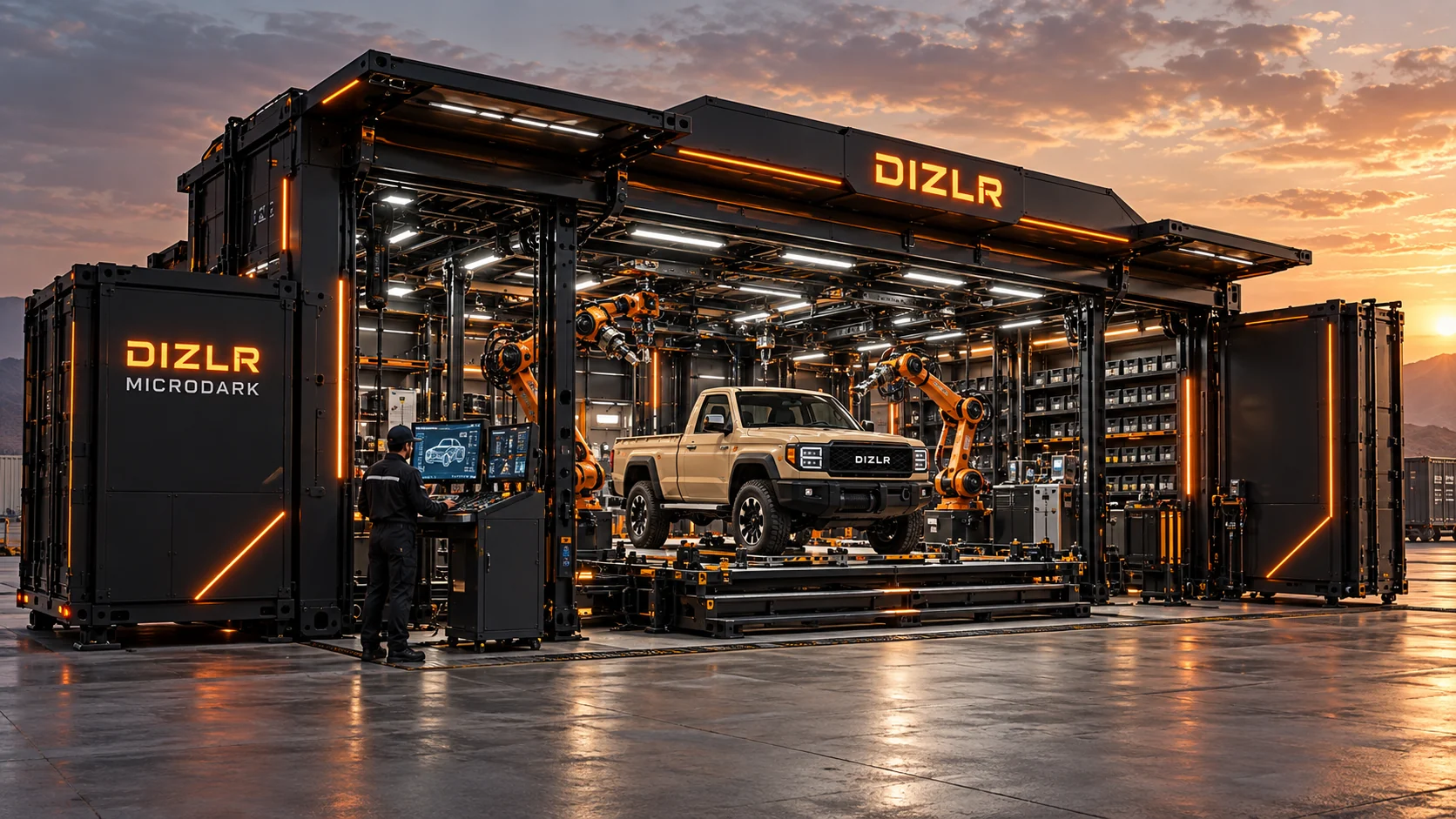
MICRODARK
DIZLR aims to develop and deploy hundreds of compact automated factories. Transportable cells would expand on site to assemble DIZLR vehicles within one engineering and digital system.
Industrial development concept · Figures are engineering targets
Target interval between two completed vehicles
vehicles per year under the extended operating scenario*
Phased growth based on demand and readiness
The vision starts with a question: what if vehicle assembly capacity could become an industrial unit that can be moved and replicated?
MICRODARK is DIZLR’s concept for that answer. It brings robotics, parts supply, inspection and digital control into a compact cell. Core modules are manufactured by suppliers, bringing final assembly closer to the markets where vehicles are used.
A model intended to add cells according to demand and site readiness.
Controlled assembly specifications, inspection procedures and operating releases.
Local operations, supply and service within DIZLR’s global vision.
A concept for a single transportable unit that expands on site: a fixed structural core, two side wings and space designed for CRUISE assembly.
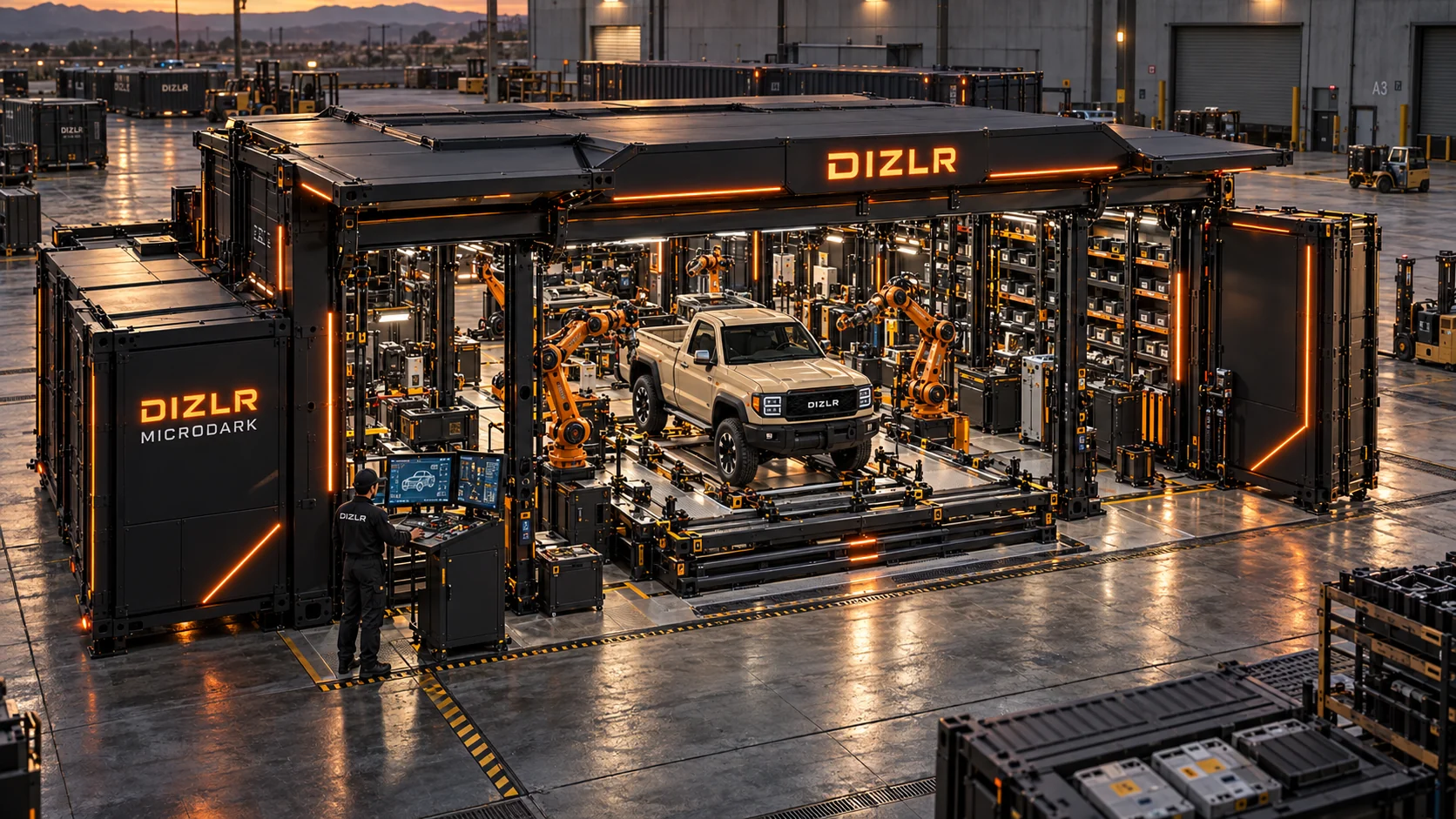 Design concept · Target dimensions
Dimensions refer to the unit’s conceptual envelope. The complete site also needs storage, handling, utilities, safety and inspection areas. Equipment folding, loads and calibration require detailed engineering.
A concept for final assembly from a chassis and preassembled modules, recording work and verification for each vehicle.
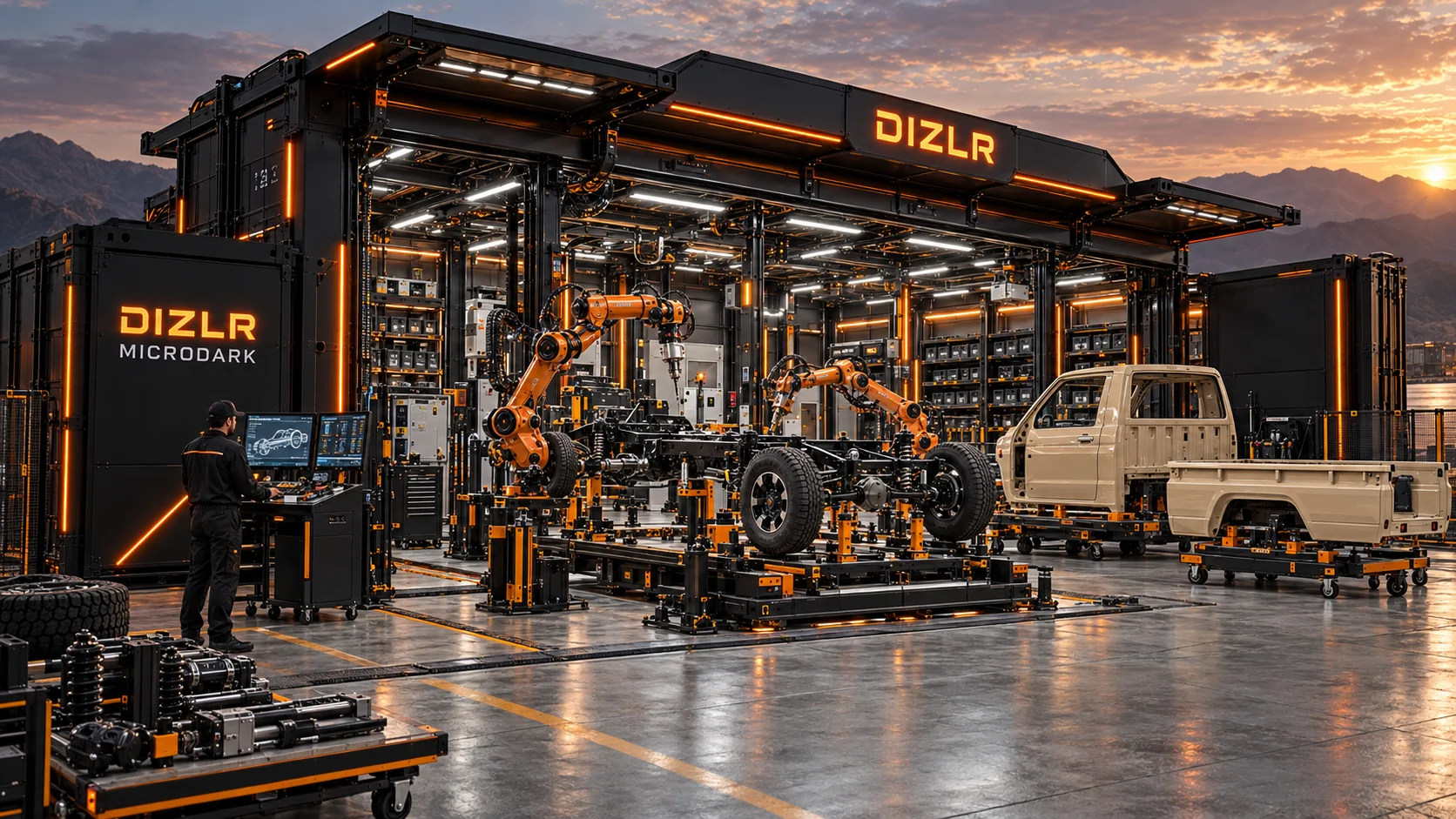 Assembly stage visualization
The sequence starts by securing the chassis on a reference platform, identifying its specification, and checking measurement points and the required parts kit.
This sequence is illustrative. The order and duration of operations depend on vehicle design, module readiness and integration test results.
The design aims to coordinate storage, handling, fastening and inspection so the cell works as one assembly system.
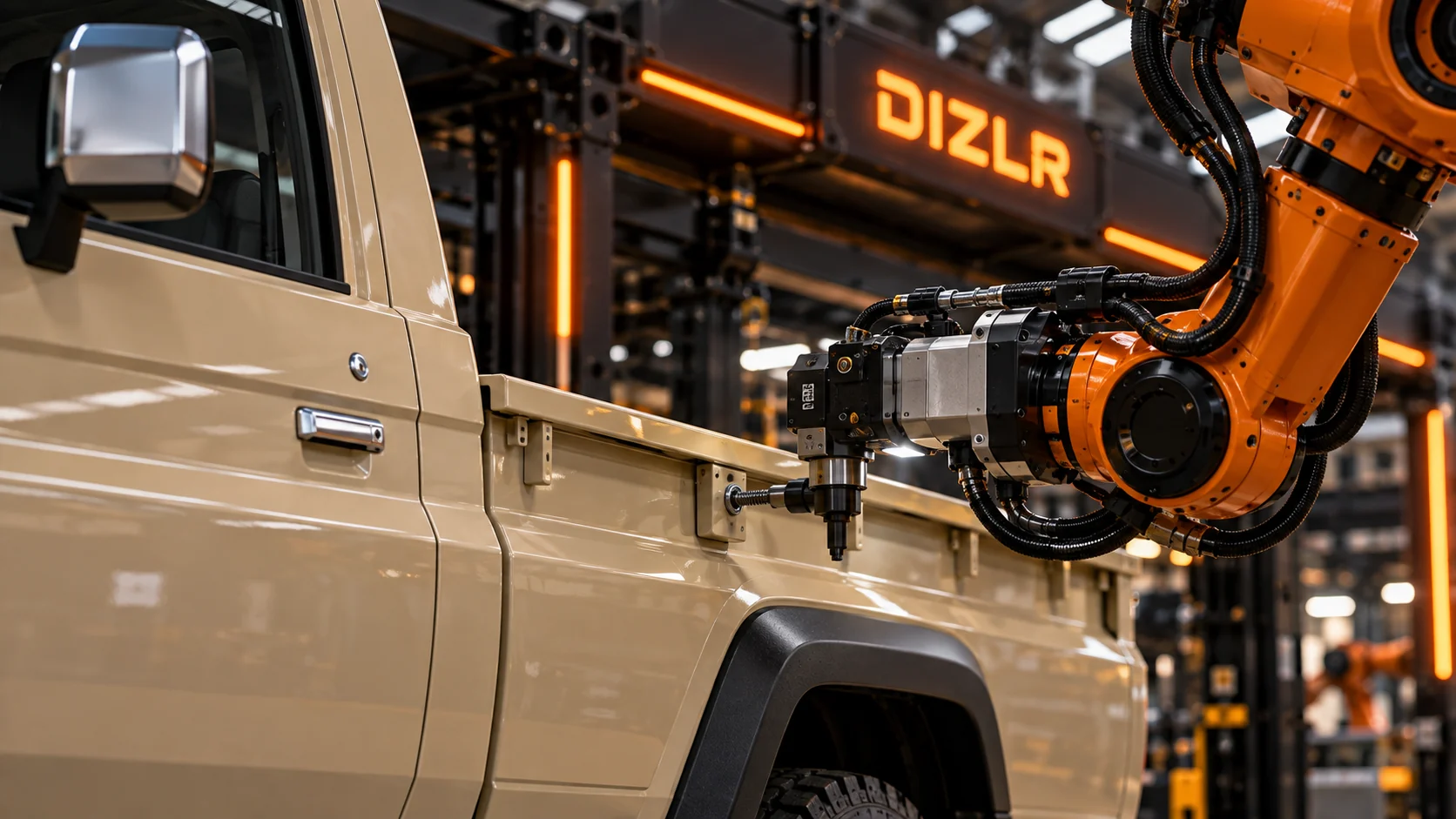
Vision and sensor guidance, compensating for deviations within approved engineering limits.
An integrated automated small-parts store coordinates selection and supply according to the vehicle specification and assembly sequence.
Select → Verify → SupplyRobots use dedicated handling, fastening and measurement tools within verified work zones and motion paths.
Handle · Fasten · MeasureTraceable production orders and engineering releases, with performance monitoring and exception handling by a specialist team.
Plan · Execute · MonitorRobot movement zones are separated from human access. Stop functions and safety controls remain independent of the AI layer.
Protect · Verify · RespondAutomated operations. Human expertise. MICRODARK aims to automate repetitive assembly, with specialist oversight for supply, maintenance, quality and exceptions.
A target production rhythm after operations and supply have stabilized.
This means the interval between two completed vehicles in a defined production configuration. Attributing that rate to a single cell requires validation of every operation within its boundaries and support from modules prepared outside it.
Total vehicle lead time and the number of supporting stations or cells require an operating study. Actual output must be demonstrated through testing.
Change the operating assumptions to explore their effect on calculated capacity.
Effectiveness combines availability, speed and quality during planned time. These are calculation assumptions, not operational readings.
vehicles under the selected assumptions
This is calculated capacity for a concept under development. Actual performance depends on cell testing and the approved operating calendar.
At one vehicle every ten minutes, 24 hours a day for 365 days, the theoretical ceiling is 52,560 vehicles. Exactly 50,000 would require about 95.13% of that annual ceiling. At an assumed 95% effectiveness, the result is 49,932 — approximately 50,000.
A scenario of 330 days × 24 hours × 85% effectiveness gives 40,392 vehicles. Annual output therefore depends on the operating calendar, component supply, reliability, speed, quality and the operations counted within the cell.
The design aims to link vehicle identity with work steps and verification results, carrying a consistent quality approach into each new cell.
From checking parts to recording fastening and measurement, the operating vision uses reviewable data and controlled corrective actions.
Discuss engineering integration ↖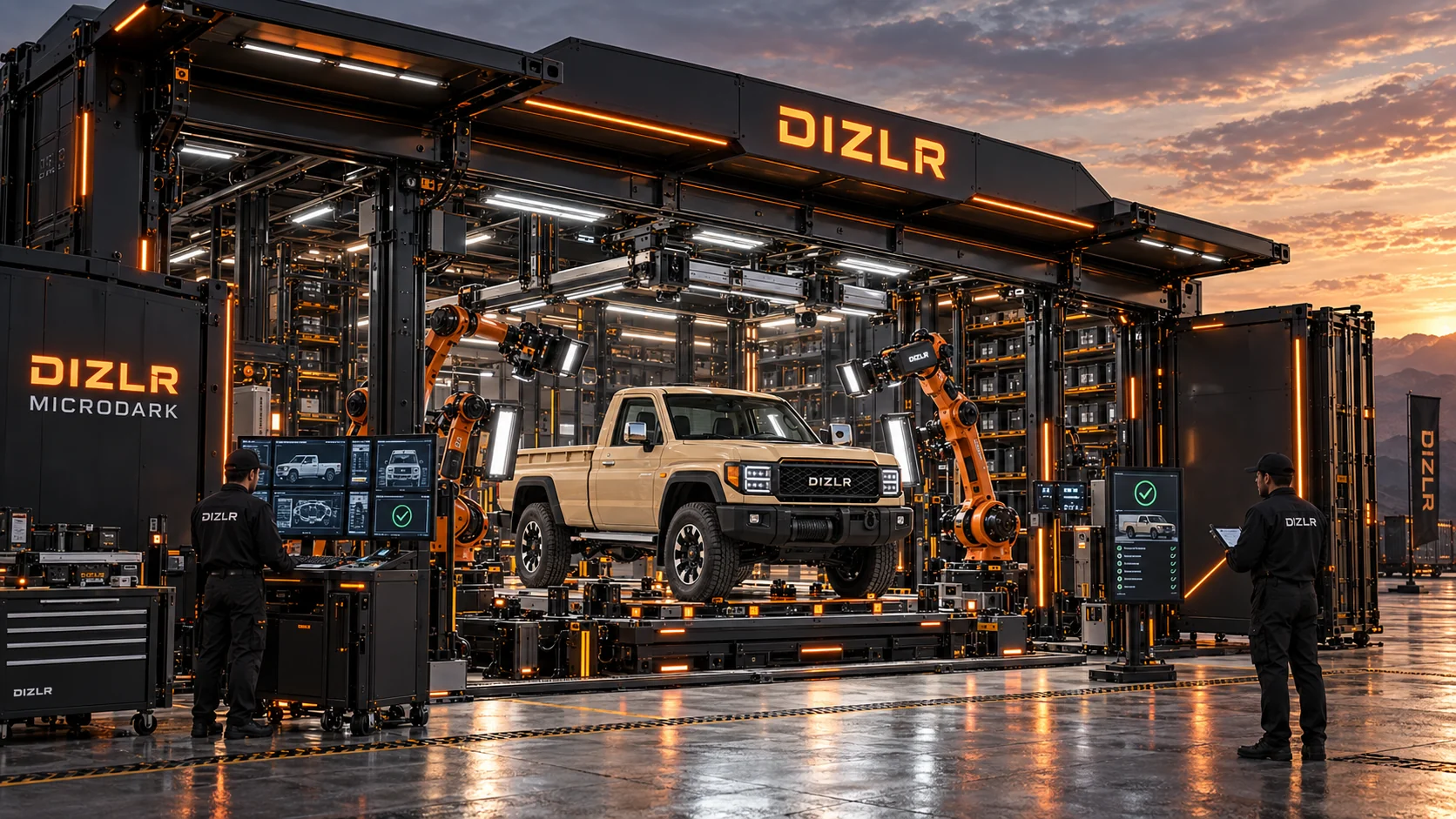 Concept visualization
DIZLR envisions a network of local assembly sites connected by common engineering and digital management, growing in phases with demand, partner readiness and supply.
In the target model, local teams prepare sites and manage operations and supply. DIZLR coordinates engineering releases, quality specifications and oversight. Locations and cell counts are determined after technical and commercial review of each project.
The MICRODARK concept creates opportunities to work with local operating, supply and engineering partners. Start by introducing your project and area of interest.
Tell us about your organization, your market and the cooperation you are considering.
This enquiry explores industrial cooperation. Scope, specifications and timing are established after reviewing the project.
The concept focuses on final assembly of DIZLR vehicles using prepared chassis and modules. Engine manufacturing, stamping, painting and other upstream processes take place within the supplier network and specialist factories.
It is a target interval between completed vehicles in a defined operating configuration after flow stabilizes. Applying it to one cell requires timing every operation, preparing parts outside the cell and approving the required inspection process. Images do not demonstrate cycle time.
At 365 days and 24 hours per day, a ten-minute interval gives a theoretical ceiling of 52,560 vehicles. Assuming 95% overall effectiveness gives 49,932. This development target depends on the assumptions and changes with the operating calendar, effectiveness and assembly scope.
Site preparation covers loads and anchoring, power and utilities, supply and large-component handling, safety areas, inspection and maintenance. The cell’s compact envelope is only part of the complete site.
The aim is to automate repetitive operations within approved engineering limits, supported by specialist people for supply preparation, maintenance, monitoring and exceptions. The final automation level depends on validation of each operation.
This page presents the MICRODARK concept through AI-generated visualizations and target dimensions. Specifications and production capabilities require engineering validation and acceptance tests for the defined operating configuration.