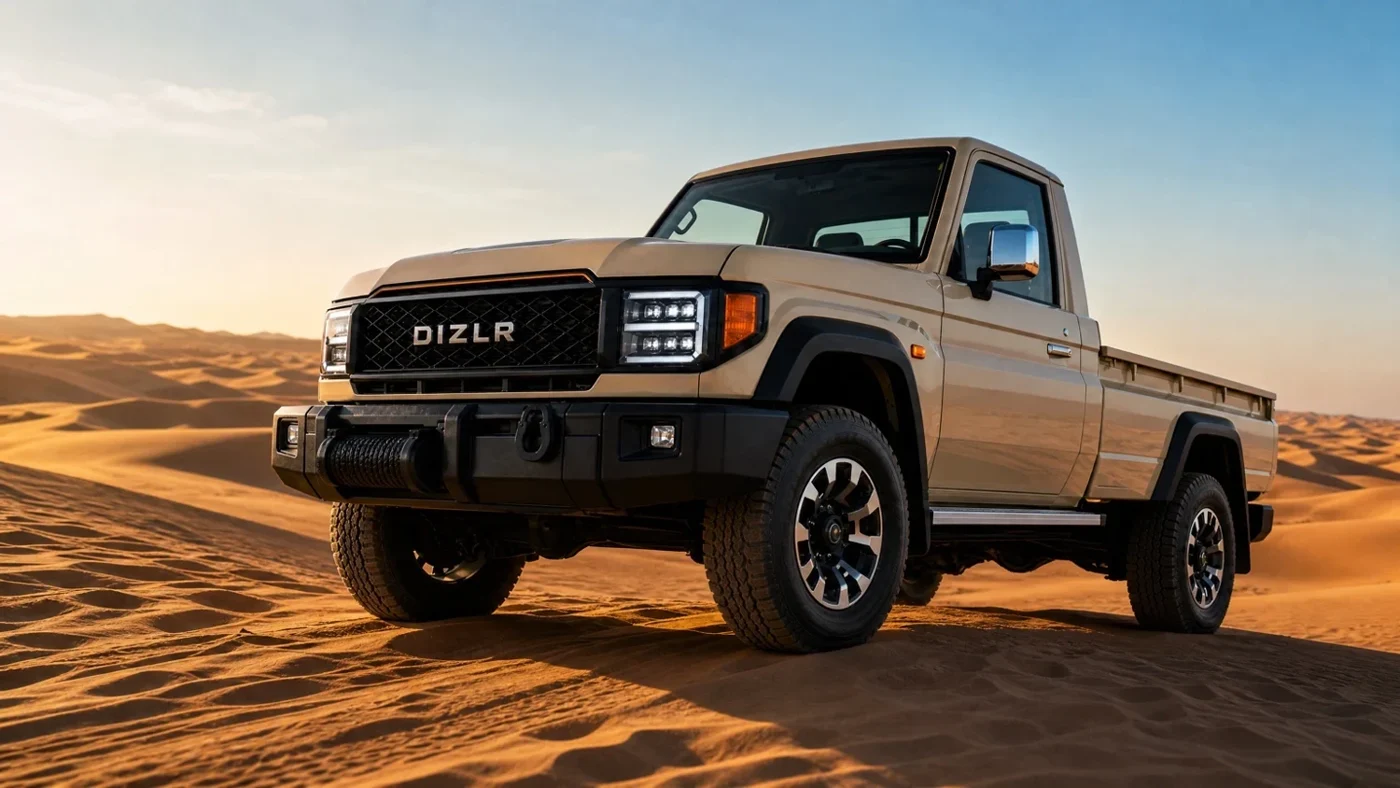
This page explains DIZLR's idea and the way of working it aims to build. Vehicle pages provide published specifications, availability and reservation terms. Future concepts are identified throughout the story so they remain distinct from what is available today.
One journey, from the first question to life after delivery
- 01Understand your needs
- 02Design and test
- 03Plan manufacturing
- 04Inspect the vehicle
- 05Support it in service
Chapter 01
Why DIZLR?
Imagine a business owner choosing a vehicle for a team. Appearance is only part of the decision. It needs to carry their tools, handle the roads they use and return to work quickly after maintenance. For that owner, a vehicle is part of everyday operations, and a problem with it costs time and income.
That is the starting point for DIZLR, an American company working in vehicle engineering, design and the development of manufacturing methods. Its focus includes the vehicle and the work behind it: selecting parts, coordinating manufacturers, inspection and service.
The idea is to bring these activities into a clear process. Designers understand the customer's needs, manufacturers know what to produce, and service teams can find the right information. Experience gained from one vehicle can then help improve the next.
What does a vehicle development platform mean?
It means a way of working that brings engineering knowledge, suppliers, production tools and data together around a project. DIZLR need not own every machine or factory, but design, execution and inspection responsibilities must be clear, alongside each party's rights and obligations.
DIZLR CRUISE is one vehicle program within this vision. Expansion into other families requires development, testing and approvals for each program and market.
Chapter 02
Start with a simple question: what work will the vehicle do?
A vehicle delivering goods in a city has different needs from one working long days in the desert. The first needs convenient loading and easy stop-and-go operation. The second may need greater attention to cooling, dust and terrain. Understanding the job comes before choosing a shape or equipment.
Those answers become specific decisions: payload, passenger numbers, daily distance, suitable components and ease of repair. Changes need to be considered together. Increasing payload, for example, may require changes to braking and suspension, not just a larger cargo bed.
As experience grows, proven parts and designs can be reused across vehicles. That creates room for different models without starting from scratch each time, while every configuration still needs testing to confirm that its parts work together properly.
How is design experience preserved?
The proposed engineering library is called Vehicle OS. It holds parts, designs, compatibility rules and manufacturing methods. Here, the name describes organized knowledge, not an operating system installed in the vehicle or an autonomous driving feature.
Future families could include pickups, light commercial vehicles, trucks, buses and specialist applications. This describes the scope of the vision, not the current availability of every product.
Chapter 03
Turn those answers into a design that can be built and repaired
Engineering begins by working out how the vehicle's parts will function together. Where does a cable run? Can a technician reach the component? Will a joint carry the required load? These may seem like small questions, but they matter when a drawing becomes a real vehicle.
Designing the part is only part of the work. The team must also define the tool that makes it and how it will be held, assembled and measured. A part can look good on a screen yet be difficult to produce or expensive to repair, so product design and manufacturing planning need to develop together.
Next come prototypes and tests. Calculations and simulation can reveal problems early, but decisions also require physical measurements and trials. The aim is a design that serves its purpose and can be manufactured repeatedly with consistent quality.
Reverse engineering, tooling and approval in plain terms
Reverse engineering means measuring and studying an existing part to understand and develop it, while respecting design rights and licenses. A 3D scan captures shape, but does not by itself reveal alloy composition or fatigue life.
Dies, fixtures and presses need their own design, trials and maintenance. Market requirements for safety, emissions and other areas must also be reviewed for the vehicle. Approval of a component does not automatically approve the whole vehicle in every country.
Chapter 04
Keep information connected from the drawing to the factory
Imagine an engineer revising a part while the factory continues using the old drawing. The problem is not the machine; it is the information reaching it. A vehicle's development needs a record of what changed, when it was approved and which vehicles it applies to.
In DIZLR's proposed approach, part drawings connect to suppliers, work orders and inspection results. If a batch develops a problem, its source and the affected vehicles can be identified without searching through disconnected files and messages.
Every team does not need to use the same software. Their systems need to exchange the right information and distinguish plans from completed work. An expected delivery date, for example, is not proof that goods have arrived.
How do the systems connect while keeping distinct roles?
Product engineering systems hold the design; resource systems manage orders and purchasing; factory systems record execution; warehouse systems track inventory. Shared part or order identifiers connect them, with a date, version and source for each update.
Asset description standards such as AAS can support data exchange where appropriate. Access is defined for each team and partner. A supplier does not necessarily need the complete vehicle design to manufacture one part.
Chapter 05
Try a change on screen before making it on the factory floor
Before moving a machine or changing an assembly sequence, it helps to find problems early. Simulation provides a model for exploring movement, time and space. Can a robot reach the work without a collision? Will parts queue up at the inspection station?
When that model is connected to data from actual operations, it is called a digital twin. It makes some decisions easier to test and compare. Its accuracy still depends on its data and limits: a successful movement on screen does not prove that a vehicle is safe.
Once a design is approved, it must become clear factory instructions: required parts, assembly order, tools and inspections. DIZLR aims to automate parts of this work to reduce manual transfer of information and make reviews easier.
How can a proven process move to another factory?
A tested process can be recorded as a package of drawings, instructions, programs and inspections. The vision calls this a Factory Image. A new site still needs a review of equipment and utilities, followed by appropriate trials; it is not a file that can simply be copied and run.
Vehicle Creation Compiler is the name for a proposed way to turn approved engineering data into a connected execution plan. It remains a development direction, not a claim that a written prompt can produce a saleable vehicle without engineers or testing.
Chapter 06
Specialist manufacturers working toward one result
A vehicle requires many kinds of expertise. One manufacturer specializes in metal components, another in tooling, while others assemble and test. DIZLR's vision is to coordinate these capabilities so each party understands its task and how its work will be accepted.
Choosing a supplier takes more than a familiar name or a photograph of a modern machine. It must demonstrate the ability to make the part with the required material, accuracy and volume. Delivery and quality need to be reviewable, with samples, batches and changes tracked as work progresses.
This makes risks easier to spot: a delayed part, a single supplier or a batch that failed inspection. When an alternative is needed, its compatibility must be reviewed and tested before use. Being available does not automatically make a part suitable for the vehicle.
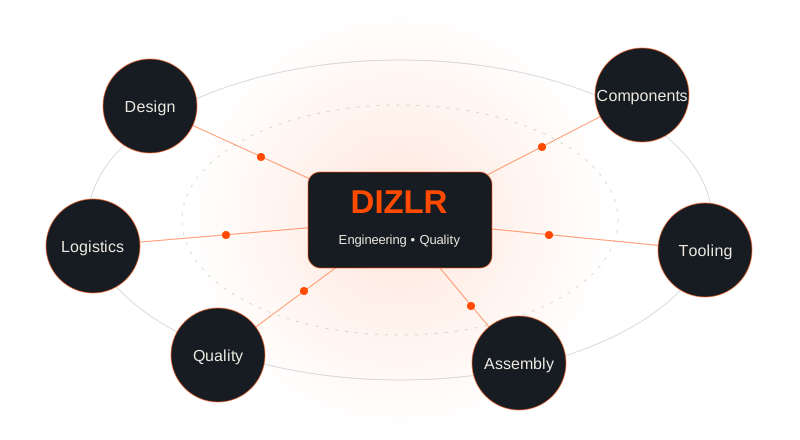
When should equipment be owned, and when should partners be used?
The decision depends on actual need, cost, quality, time and demand. Developing a dedicated tool may be appropriate, or a specialist manufacturer may be the better choice. Estimates are reviewed before commitment, and authorized people remain responsible for investments and contracts.
Rights to drawings and tooling, including use and transfer, also need to be documented. The supplier-network concept does not imply owned factories in every market or partnerships with every company named in the references.
Chapter 07
Get the right part to the work when it is needed
A full warehouse is little help if the assembly team is missing the part it needs. Material planning starts with the vehicles scheduled for production: which parts are required, when are they needed, and have they passed inspection? The aim is to deliver the right set of parts to the right workplace at the right time.
Automated storage can help. The system knows a part's location and status, and handling equipment moves it to the assembly area. A part held because of a problem must not be released simply because it is on the shelf.
One approach DIZLR is exploring uses flexible work areas where parts and tools arrive around the vehicle. It may begin with partially completed assemblies and expand after process quality is demonstrated. Suitable buffers for critical parts still matter: lower inventory is no advantage if it repeatedly stops production.
Just-in-time production and flexible assembly explained
Just-in-time, or JIT, links material replenishment to consumption and the needs of the next stage. It does not mean having no inventory. AS/RS refers to automated storage and retrieval systems, with equipment selected for part sizes and weights.
SKD assembly means bringing together partially completed assemblies. It is different from operating a full stamping, welding and painting plant. Each assembly area needs correct instructions, suitable tools and clear inspections before capacity is expanded.
Chapter 08
Where can AI help, and where must people decide?
As information about parts, suppliers and inspections grows, analyzing it becomes an important task. AI can help find an approved reference, compare alternatives or flag a delay or recurring defect. Its value is in helping a team notice something it might otherwise miss.
A robot performs physical work: moving, holding or inspecting a part. It should be chosen for the task and tested under defined conditions. A change in part weight, tooling or lighting may require another test before its output can be relied upon.
DIZLR aims to increase automation gradually, starting with repetitive, well-understood work. A software suggestion does not become a machine command without review, and engineers, maintenance and safety remain necessary. The more a system can do independently, the more important it becomes for it to know when to stop and request help.
What about automated factories and robots building robots?
Highly automated operations can run for defined periods without repeated intervention, supported by monitoring, maintenance and safe stopping procedures. This is a future direction in DIZLR's vision, not a claim of an existing autonomous factory.
Existing equipment may make tooling or some components for new equipment. That is the practical meaning of robots contributing to building robots; they do not independently produce every motor, sensor and chip. AI agents likewise remain specialist assistants with defined permissions, without bypassing safety systems or human approval.
Chapter 09
The vehicle reaches the road, and its story continues
After assembly and inspection, a vehicle has a history worth preserving: its installed parts, completed tests and later changes. DIZLR aims to bring that information into a vehicle-linked record that supports service and helps trace problems affecting it.
Ease of maintenance begins long before delivery. During design, the team considers how a technician reaches a part, which tools are needed to remove it and how to identify the correct replacement. Customers need their vehicles back at work, not a complicated repair caused by a decision that could have been improved earlier.
Experience in use then returns to engineering. If a fault repeats or a repair takes too long, the cause can be investigated and an improvement tested. This is how the vehicle, its manufacturing and its service develop: through documented observations and measurable trials.
What belongs in a vehicle record?
It can include the as-built configuration, important parts and their batches, inspection results, and later maintenance, replacements and any software updates. Each user sees the information appropriate to their role, with customer data protected.
Every vehicle does not need a permanent internet connection; documented service records can be a starting point. Using operational data or new methods to manufacture replacement parts still requires appropriate consent, validation and approval. It does not make every part interchangeable or suitable for printing.
Chapter 10
What customers tell us feeds back into planning
The story does not run only from factory to customer. Your questions, choices and experience reveal real market needs. DIZLR aims to connect sales and customer service with product planning, while distinguishing initial interest, an approved reservation and an order in execution.
That connection can also make order tracking clearer. A status should have a source and date behind it, rather than a progress bar advancing without an actual event. Reservation, payment and contract records stay linked to the correct customer, and an inquiry is not treated as the start of manufacturing.
Once engineering and manufacturing capabilities are demonstrated, the experience could support future partner projects, such as a specialist vehicle application or a fleet adaptation. Each begins with a defined scope and clear responsibilities, expanding as results are proven.
Reservations and production participation have their own terms
Customer and sales systems help organize inquiries and follow-up. Contracts, payments and production participation are governed by the published terms of each program. This page adds no fees, payment terms, promised returns or resale commitments.
Offering manufacturing capabilities to partners is a future expansion direction, not an announcement of a currently operating open marketplace. Each project requires a review of supplier qualification, design rights, tests and responsibilities.
Chapter 11
Where could this idea lead?
DIZLR's future vision includes a multistory industrial facility bringing engineering, trials, flexible assembly and automated storage together. The idea is to keep development teams close to the equipment used to test their ideas and move parts between them in an organized way.
A tall building does not become an effective factory simply by putting machines inside it. Loads, vibration, ventilation, fire safety and the movement of materials and people all need study. Heavy pressing or painting may be better suited to separate buildings. The tower is therefore presented as a research concept requiring evaluation and proof, not an existing facility.
Resource use matters more than the building's shape. How much energy and water does a process consume? Where is material wasted? Can packaging or heat be reused without affecting quality? Answers begin with measurement, followed by a comparison of actual improvement and cost.
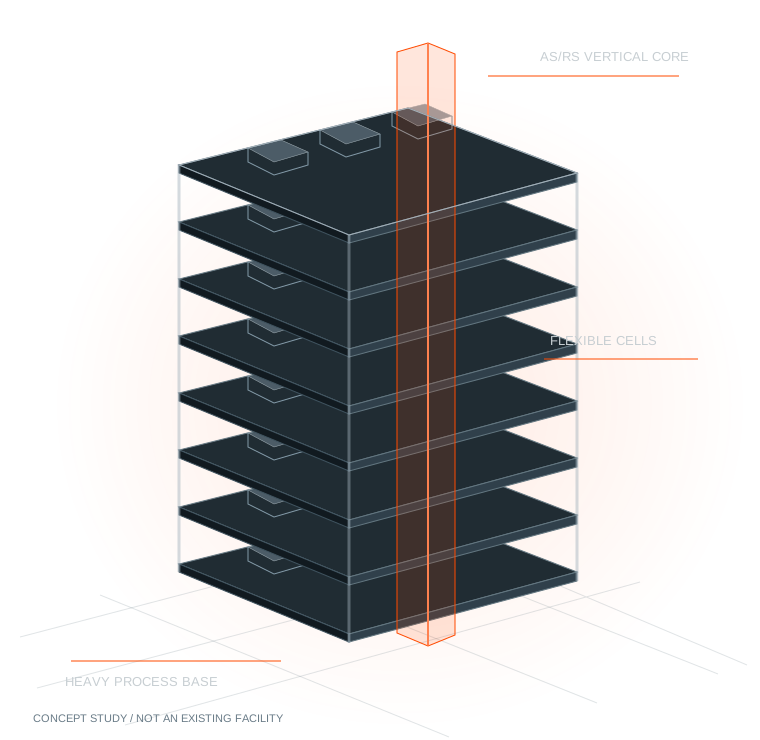
Would all production need to move into the tower?
No. It could be a place to develop and test ideas, with proven processes transferred to other sites in the network. Vertical and horizontal buildings would also need a feasibility comparison, rather than assuming that height is always cheaper or better.
The published vision does not establish that this would be the world's first such facility or that DIZLR owns it today. Resource savings or lower emissions also require measurements and a defined basis of comparison before they can be claimed.
Chapter 12
From a vision to results people can trust
None of this is built in a single step. It starts with a well-defined vehicle, a tested design and qualified manufacturers. Traceability and work organization can then improve, with wider automation introduced when its value and quality are demonstrated.
Every stage needs a result that can be reviewed: a sample passing inspection, a more stable process or a measured reduction in repair time. Technology names alone are not enough, and concept imagery cannot replace a tested vehicle or an operating factory.
That is the ambition connecting DIZLR's story: vehicles suited to their intended work, and a development and manufacturing approach that learns from experience. This page explains the direction and the thinking behind it. Implemented capabilities should be supported by evidence, while each vehicle's specifications and terms remain on its dedicated page.
How do we distinguish progress from plans?
Each capability needs a defined scope, test or operating results and reviewable records. Approvals, specifications and warranties apply to the relevant market and model; they do not automatically extend to everything described in the vision.
This page does not announce an existing fully autonomous factory or industrial tower, or publish unproven automation rates, production capacity or savings. Project updates should reflect what has actually been implemented.
For you, it starts with the vehicle you need.
Visit the DIZLR CRUISE page for published model information and reservation options. This story explains the vision; the vehicle page provides the information for your decision.
Explore DIZLR CRUISEExplore further: references and industrial examples
These sources explain ideas discussed in the story. Naming a company or organization does not imply a partnership with DIZLR or an endorsement of its capabilities.
- Toyota — Toyota Production System ↗
- Siemens Solid Edge — Reverse Engineering ↗
- Daifuku — Automated Storage & Retrieval ↗
- Hyundai — HMGICS Grand Opening, 2023 ↗
- FANUC — Factories ↗
- NIST — AI Risk Management Framework ↗
- NIST — Guide to OT Security, SP 800-82 Rev. 3 ↗
- IDTA — AAS Submodel Templates ↗
- NVIDIA — Digital Twin ↗
- Catena-X — Automotive Data Ecosystem ↗
- BMW Group — Additive Manufacturing ↗
- INCOSE — Systems Engineering Vision 2035 ↗
- Siemens — AI Agents in Industrial Operations ↗
- Hyundai — HMGICS Manufacturing Technology ↗
- NIST — Digital Twins for Advanced Manufacturing ↗
Vehicle images are DIZLR concept materials. Diagrams explain ideas; they do not depict existing facilities or approved manufacturing drawings.